Universal Declaration of Human Rights
The Universal Declaration of Human Rights (UDHR) stands as one of the most important documents in modern history. Adopted in 1948, it established a universal standard for human dignity, freedom, and equality across the world. Despite being over seven decades old, its relevance continues to grow in today’s global society.
In this detailed article, we will explore the history, key principles, creators, impact, fun facts, and more about the UDHR.
What is the Universal Declaration of Human Rights?
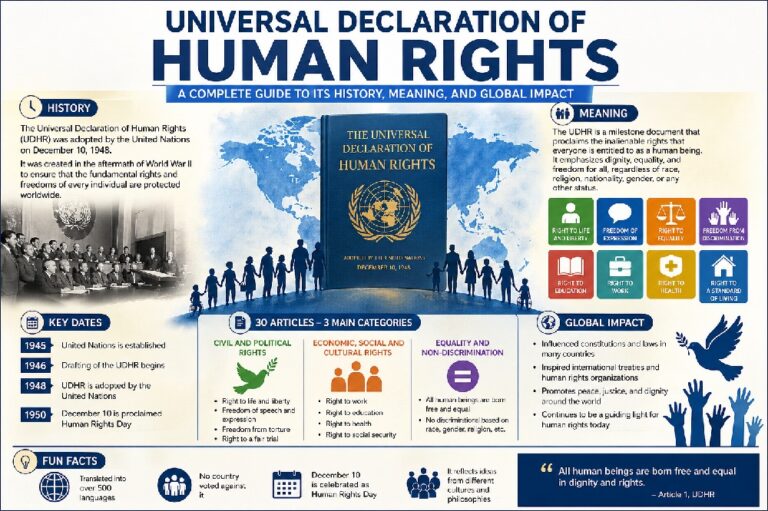
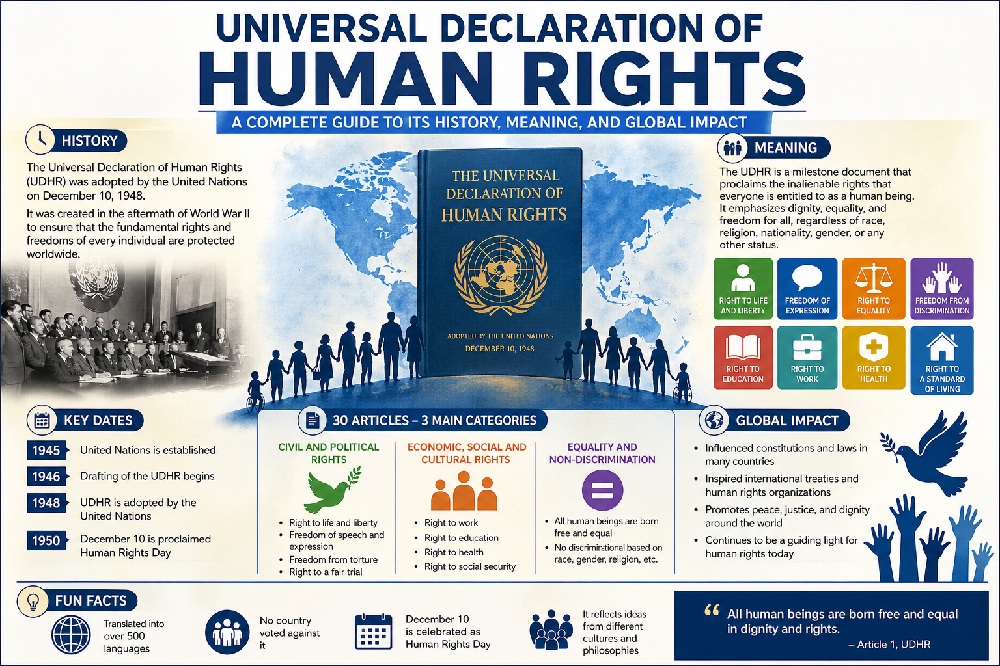
The Universal Declaration of Human Rights is a landmark document adopted by the United Nations on December 10, 1948. It outlines 30 fundamental rights and freedoms that belong to every human being, regardless of nationality, race, religion, or gender.
It is not a legally binding treaty, but it has influenced international laws, constitutions, and policies worldwide.
Key Purpose
- To protect human dignity
- To ensure freedom and equality
- To promote justice and peace globally
Historical Background
Table of Contents
The UDHR was created in response to the horrors of World War II. The war exposed extreme violations of human rights, including genocide, forced labor, and mass destruction.
After the war, global leaders realized the need for a universal framework to prevent such atrocities in the future.
Formation of the United Nations
In 1945, the United Nations was established to promote peace and cooperation among nations. One of its first major tasks was to draft a document that would define human rights for all people.
Key Figures Behind the UDHR (Bio Section)
Eleanor Roosevelt
- Full Name: Anna Eleanor Roosevelt
- Born: October 11, 1884
- Nationality: American
- Role: Chair of the UDHR drafting committee
- Known For: Leading the creation of the declaration and advocating for human rights worldwide
Biography:
Eleanor Roosevelt played a crucial role in shaping the UDHR. As a former First Lady of the United States, she used her influence to promote equality and justice. She was known as the “First Lady of the World” due to her humanitarian efforts.
Net Worth:
At the time of her death in 1962, her estimated net worth was modest compared to modern standards, reflecting her focus on public service rather than wealth.
Hobbies & Interests:
- Writing and journalism
- Social activism
- Public speaking
René Cassin
- Born: October 5, 1887
- Nationality: French
- Role: Main drafter of the UDHR
- Award: Nobel Peace Prize (1968)
Biography:
René Cassin was a legal expert who structured the UDHR. His work laid the foundation for modern human rights law.
Net Worth:
Not widely documented, but his contributions were more intellectual and humanitarian than financial.
Hobbies & Interests:
- Legal research
- Advocacy for justice
- Academic writing
The 30 Articles of the UDHR
The UDHR contains 30 articles, each focusing on a specific human right. These rights are divided into categories:
1. Civil and Political Rights
- Right to life and liberty
- Freedom of speech
- Freedom from torture
2. Economic, Social, and Cultural Rights
- Right to education
- Right to work
- Right to healthcare
3. Equality and Non-Discrimination
- All humans are born free and equal
- No discrimination based on race, gender, or religion
Important Principles of the UDHR
1. Universality
Human rights apply to everyone, everywhere.
2. Equality
All individuals are equal regardless of differences.
3. Inalienability
Rights cannot be taken away except in specific legal situations.
4. Interdependence
All rights are connected—violating one affects others.
Global Impact of the UDHR
The UDHR has influenced many important documents and laws, including:
- National constitutions across the world
- International treaties like the International Covenant on Civil and Political Rights
- Human rights organizations’ policies
Example of Influence
Countries like India have incorporated many UDHR principles into their Constitution, especially fundamental rights.
Fun Facts About the UDHR
- Over 500 languages: It is one of the most translated documents in the world.
- No country voted against it: Though some abstained, none opposed it.
- Adoption date: December 10 is celebrated as Human Rights Day globally.
- Inspired by multiple cultures: It reflects ideas from different philosophical traditions.
Why the UDHR Still Matters Today
Even in the 21st century, the UDHR remains highly relevant due to:
1. Rising Inequality
Economic gaps highlight the need for fair rights.
2. Freedom of Expression Issues
Many countries still restrict speech and press.
3. Refugee and Migration Crises
Millions rely on human rights protections for safety.
Criticism of the UDHR
While widely respected, the UDHR has faced criticism:
1. Not Legally Binding
It serves as a guideline rather than enforceable law.
2. Cultural Differences
Some argue it reflects Western values more than global diversity.
3. Implementation Challenges
Many countries struggle to fully apply its principles.
Hobbies and Activities Linked to Human Rights Advocacy
People inspired by the UDHR often engage in:
- Volunteering with NGOs
- Writing and blogging on social issues
- Participating in protests and awareness campaigns
- Legal advocacy and policy work
Modern Organizations Promoting UDHR Values
Several organizations continue to promote its principles:
- Amnesty International
- Human Rights Watch
- United Nations Human Rights Council
These groups work to monitor violations and promote justice globally.
Key Dates and Timeline
- 1945: United Nations established
- 1946: Drafting of UDHR begins
- 1948: UDHR adopted
- 1950: Human Rights Day established
Net Worth Perspective (Conceptual Section)
Unlike individuals or celebrities, the UDHR does not have a monetary value. However, its “global worth” is immeasurable, as it has:
- Influenced billions of lives
- Prevented human rights abuses
- Inspired legal frameworks worldwide
Conclusion
The Universal Declaration of Human Rights is more than just a document—it is a symbol of hope, equality, and justice for humanity. Created in the aftermath of global tragedy, it continues to guide nations toward a more fair and humane world.
About the Author